Introduction
Air Traffic Controller training is one of the most evidence-sensitive training environments in aviation. It is not enough to deliver a course, record attendance, or issue a certificate. Training organizations must be able to show how a controller was trained, what objectives were covered, who assessed performance, what evidence supports the decision, and when competence or recurrency must be reviewed again.
Yet many ANSPs and aviation training organizations still manage this lifecycle across fragmented systems: spreadsheets, shared folders, PDF forms, emails, simulator logs, generic LMS platforms, manual calendars, and local databases. Each tool may solve a small operational problem, but together they often fail to provide one reliable view of ATCO training status.
Why this matters now
ATCO training is shaped by formal licensing, competency, assessment, continuation training, and record-keeping expectations. ICAO’s training framework emphasizes competency-based training and assessment principles, while European ATCO licensing and certification requirements under Commission Regulation (EU) 2015/340 establish structured expectations around training, competence assessment, instructors, assessors, ratings, endorsements, and continued competence.
For ANSPs, the practical issue is governance. Training managers need to know not only whether a learner completed a module, but whether the organization can defend the training record during an internal review, authority inspection, or safety-related investigation.
Why ATCO training records remain fragmented
Fragmentation usually does not happen because teams are careless. It happens because ATCO training is operationally complex. Classroom learning, simulator sessions, on-the-job training, refresher training, instructor observations, assessor decisions, recurrent checks, and evidence retention often evolved in separate workflows over many years.
A typical ATCO training environment may include:
- a general LMS for e-learning content and quizzes;
- spreadsheets for competence and recurrency tracking;
- PDF or paper forms for instructor and assessor observations;
- shared folders for evidence, certificates, and training packs;
- separate simulator records or attendance exports;
- manual calendars for recurrent training and refresher sessions;
- email chains for approvals, exceptions, and sign-offs.
The problem appears when managers need a complete answer. A course completion record does not necessarily prove objective-level competence. A simulator attendance log does not show which objectives were assessed. A certificate does not always explain the evidence behind the decision. A spreadsheet may show a due date, but not the supporting record that justifies it.
The operational cost of disconnected training systems
When training data is spread across tools, the organization spends too much time reconstructing certainty after the fact. This creates several recurring problems.
- No single qualification view: managers must check multiple sources to know who is current, overdue, suspended, or at risk.
- Weak objective traceability: course completion may be visible, but the link between objectives, assessments, evidence, and assessor verification is unclear.
- Manual recurrence tracking: refresher training, reassessment windows, and validity periods may depend on spreadsheets or individual reminders.
- Slow audit preparation: evidence must be collected from emails, folders, LMS exports, and local records before it becomes reviewable.
- Inconsistent records between units: different instructors or training batches may use different templates, naming conventions, and evidence standards.
- Limited early warning: teams may discover missing evidence, overdue checks, or learner risk too late in the cycle.
For a safety-critical workforce, this is more than an administrative burden. It weakens training governance and makes it harder for leaders to maintain real-time confidence in operational readiness.
What a better model looks like
A modern ATCO training environment should not simply digitize old forms. It should connect training delivery, objective mapping, evidence capture, assessment, qualification status, recurrence, and reporting into one governed record.
That means the system should help answer questions such as:
- Which ATCO objectives are covered by this course, lesson, quiz, live session, or practical assessment?
- Which learners have achieved each objective, and what evidence supports that result?
- Which assessor or instructor verified the outcome?
- Which qualifications are current, due soon, expired, or missing validity data?
- Which learners are at risk because of overdue work, repeated failures, stalled progress, or pending manual review?
- What can be exported for internal quality assurance or regulatory review?
How AviaGov LMS helps ATCO training teams
AviaGov LMS is designed for aviation organizations that need training governance, not just course hosting. It supports LMS delivery, competency evidence, qualification oversight, live-session evidence, cohort management, analytics, and compliance-oriented records in one aviation governance environment.
1. ATCO objective alignment
AviaGov LMS supports ATCO objective catalogs, framework packs, objective-to-course mapping, and objective-level learner evidence. This allows training managers to connect courses, lessons, quizzes, activities, and live sessions to defined ATCO objectives rather than treating training content as isolated material.
The result is clearer traceability: what was trained, where it was assessed, who completed it, and what evidence supports the achievement.
2. Competency and qualification ledger
The platform includes competency and qualification ledger capabilities that combine objective evidence, enrollments, course completion, certificates, learner standing, and qualification signals. Instead of reconciling multiple spreadsheets and folders, managers can review learner status from a centralized training record.
3. Training governance workspace
AviaGov LMS includes a training governance workspace for qualification programs, recurrence policies, qualification records, assessor authorities, compliance packs, and export profiles. This helps organizations manage training as a governed lifecycle, not only as a set of courses.
4. Evidence-based assessment
The LMS supports quizzes, file submissions, manual grading, rubric templates, reusable question banks, objective evidence, assessor verification, and gradebook workflows. This helps instructors and assessors preserve the reasoning and evidence behind training outcomes.
5. Cohorts, segments, and recurrent delivery
ATCO training is often organized by unit, cohort, rating group, operational segment, or recurrent cycle. AviaGov LMS supports cohorts, sections, groups, due dates, segment-aware visibility, learner standing, and scheduled delivery. Training managers can organize delivery by operational context while maintaining centralized oversight.
6. Live training and attendance evidence
Instructor-led training, refresher sessions, briefings, and hybrid events can be managed through AviaGov LMS live-session workflows. The platform supports scheduling, reminders, instructor resources, learner resources, attendance evidence, recordings, Q&A, breakout activities, and post-session outcome reports.
This helps convert live training from a separate calendar event into a traceable part of the learner record.
7. Analytics for learner risk and compliance exceptions
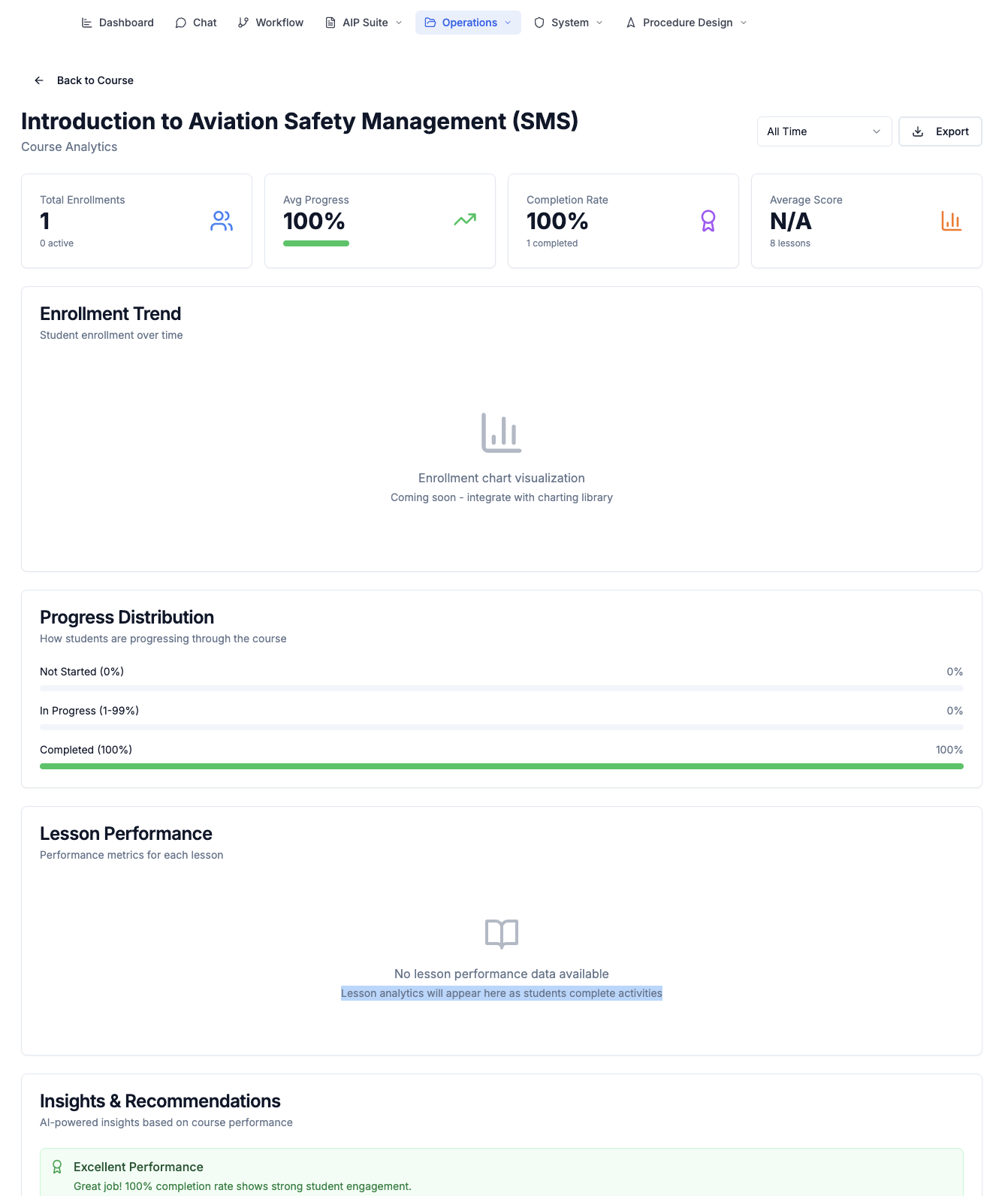
AviaGov LMS includes analytics for at-risk learners, compliance exceptions, overdue evidence, pending reviews, expired qualifications, and reassessment-due items. Managers can detect training gaps earlier instead of waiting for manual spreadsheet reviews.
8. Audit-ready exports and reporting
Training export profiles, gradebook exports, qualification records, certificates, evidence records, and learner standing views help organizations prepare structured outputs for quality assurance, management review, or regulatory inspection.
From course delivery to training governance
The future of ATCO training management is not another standalone spreadsheet or a generic LMS with aviation labels added later. The future is governed competency management: one structured environment where training delivery, objectives, assessment, evidence, recurrence, and qualification status remain connected.
AviaGov LMS helps ANSPs and aviation training organizations reduce fragmentation by bringing these elements together in a platform designed around aviation governance. The benefit is not only better administration. It is stronger visibility, more consistent evidence, faster audit preparation, and better confidence in the training status of safety-critical personnel.
Conclusion
ATCOs work in an environment where competence must be maintained, evidenced, and reviewed continuously. Training systems should reflect that reality. When records are fragmented, organizations lose time, visibility, and assurance. When records are connected, training managers can focus on improving competence rather than rebuilding evidence.
AviaGov LMS supports that shift by helping aviation organizations connect learning, assessment, objective evidence, qualification oversight, recurrent training, and reporting in one governed platform.
Explore AviaGov LMS or discuss ATCO training governance with AviaGov.
References
- ICAO, Procedures for Air Navigation Services — Training (PANS-TRG), Doc 9868.
- ICAO, Annex 1 — Personnel Licensing.
- Commission Regulation (EU) 2015/340 laying down technical requirements and administrative procedures relating to air traffic controllers' licences and certificates.
- EASA, Easy Access Rules for Air Traffic Controllers' Licensing and Certification.
- EUROCONTROL aviation training and air traffic controller training resources.
- AviaGov LMS current feature documentation, May 2026.